
INTEGRATED LEARNING ACROSS GENERATIONS TO BUILD PATHWAYS FOR ECONOMIC MOBILITY
The Academy for Urban Scholars empowers the youth and adults with education, emotional skills, and technical knowledge to achieve financial stability and create lasting community impact
Traditional public schools aim to serve all students, but for some, those with alternative education plans, behavioral challenges, or histories of expulsion, these systems often fall short.
“A traditional school would’ve given up on my son, Ramon, but at AUS, they make sure that he has all of the tools to succeed.” said Cierra Mills, AUS parent.
Students like Ramon, who struggle in conventional classrooms, can experience disengagement, exposure to violence, and the effects of poverty or neglect. Schools like the Academy for Urban Scholars (AUS) provide parents like Cierra with a supportive environment that prioritizes social and emotional development, nurtures each child’s potential, and equips them with the skills and guidance needed to pursue meaningful careers.
AUS, operating under the umbrella of the National Center for Urban Solutions (NCUS), takes a fundamentally different approach. At AUS, students receive personalized instruction and mentorship in an environment that prioritizes social-emotional growth, resilience, and trust.

(Photo caption: teacher & scholar having fun with a lesson. Original photo.)
Unlike traditional schools that struggle to support students labeled as “troubled,” AUS holds fast, nurturing each scholar’s potential, helping them overcome personal and systemic barriers, and ensuring they are seen, supported, and prepared for both academic and life success.
“Many of our scholars come to us after being told, directly or indirectly, that they can’t succeed. We reject that narrative,” said Dr. Corey Yoakam, superintendent, AUS. “Our mission is to empower students to become college-ready, work-ready, and socially responsible leaders. That starts with creating an environment where they feel supported, valued, and capable of achieving their goals.
AUS serves 9th–12th-grade students with personalized instruction while also providing adult learners the opportunity to complete high school diplomas.
Integrated into AUS is NCUS TEC, the parent organization’s technical institution and workforce development arm, where students can earn degrees, obtain industry-recognized certifications, and gain a head start on advancing their careers.
Many charter schools offer academic instruction, but few provide a fully accredited career pathway that equips students for meaningful employment.
“I like that AUS has a work academy because I can get a headstart in my career. They help you get to where you want to be in life.” said Dominic, an AUS scholar.
By delivering a continuum of learning across generations, NCUS ensures that both youth and adults acquire the skills and credentials needed to achieve financial stability and sustainable, high-demand careers.
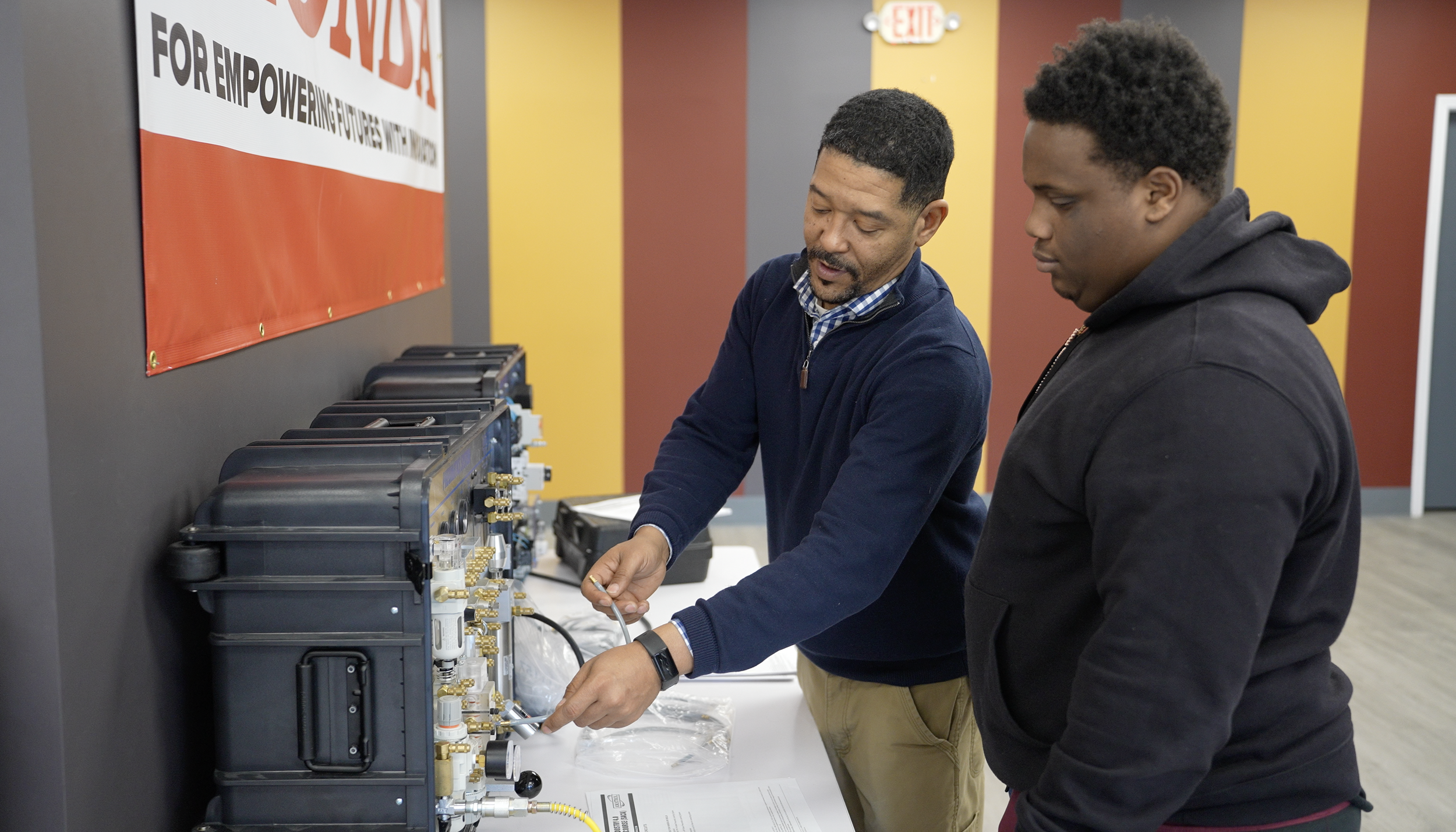
(Photo caption: scholar receiving instruction from NCUS TEC instructor. Original photo.)
Through NCUS TEC, students gain industry-recognized technical skills, including IT, construction, healthcare, advanced manufacturing, and fiber optics. with workforce demands.
The programs extend beyond technical skills. AUS and NCUS TEC integrate wraparound supports such as mentorship, soft skills development, and career counseling, addressing both educational and social barriers that often prevent success in underserved communities.
"Education does not end in the classroom; it extends into careers and life,” said Drs. Gregory, founders of NCUS. “By combining AUS’s academic instruction with NCUS TEC’s workforce development programs, we create an integrated pathway that equips both youth and adults with the skills, credentials, and confidence to thrive in high-demand industries.
This integrated learning model creates measurable economic mobility. High school students entering AUS are positioned for college, military, or career success, while adult learners acquire credentials that can increase lifetime earnings and provide stable employment. In doing so, NCUS programs strengthen families and communities, creating a ripple effect that extends across neighborhoods.